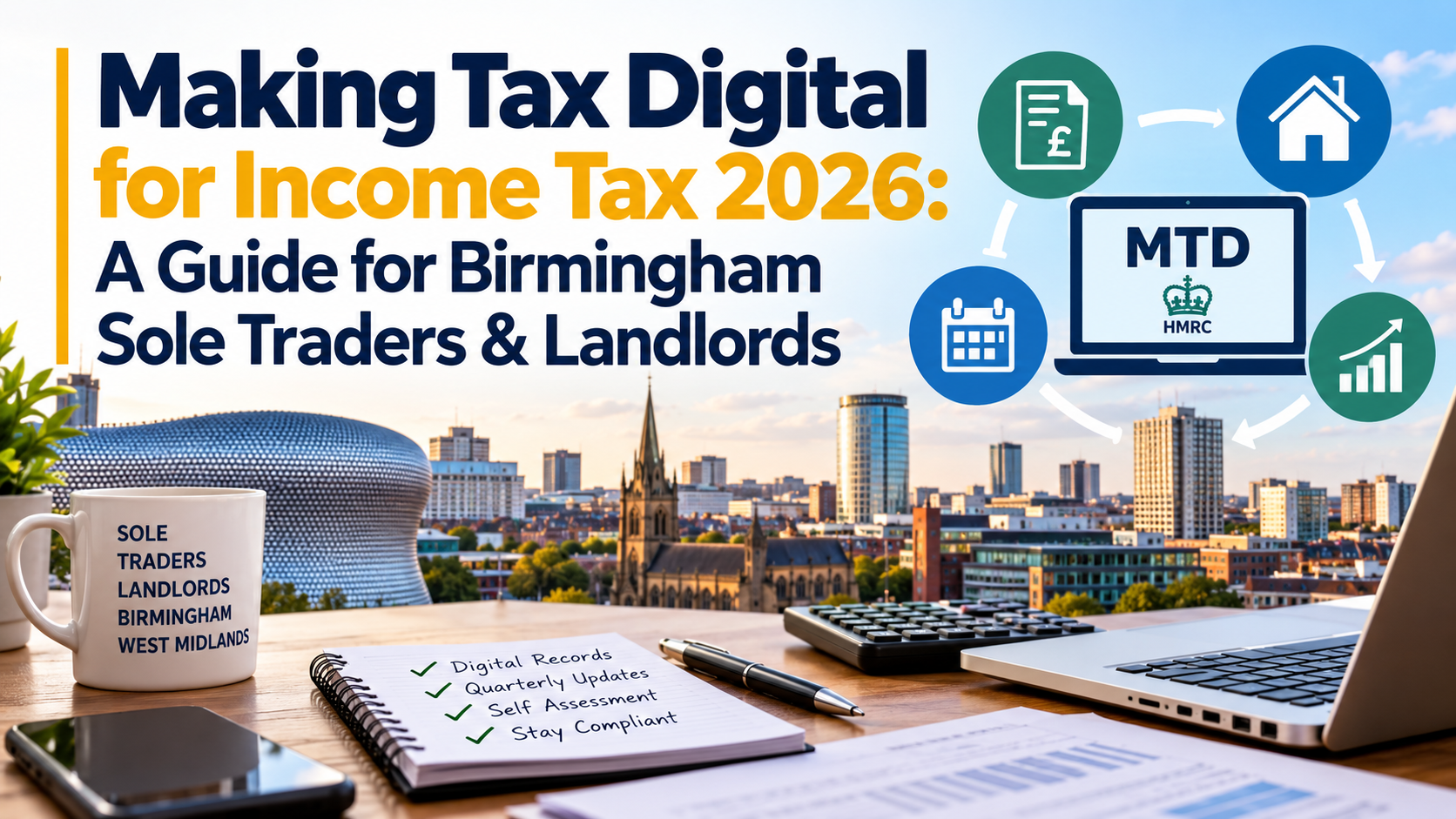
If you are a sole trader or landlord in Birmingham or the West Midlands, Making Tax Digital for Income Tax may now affect the way you keep records and report information to HMRC.
Since 6 April 2026, qualifying sole traders and landlords with total annual gross income from self-employment and property of more than £50,000 must use Making Tax Digital (MTD) for Income Tax. The system requires compatible software, digital records and quarterly updates to HMRC. The first quarter covered the period April, May and June and had to be filed in early August. The second quarter is covering July to September and needs to be filed by early November.
Official guidance: HMRC – Making Tax Digital for Income Tax
What is Making Tax Digital for Income Tax?
Making Tax Digital for Income Tax is HMRC’s digital reporting system for certain individuals who receive income from self-employment, property, or both. Instead of relying on records being assembled only around the annual Self Assessment deadline, people within the rules must maintain relevant digital records using compatible software and send quarterly updates.
Quarterly updates are summaries of income and expenses from the digital records. They are not four separate tax returns, and the normal deadline for paying the final Self Assessment tax bill remains 31 January following the end of the tax year.
Who needs to use MTD in 2026?
For the 2026/27 tax year, the key threshold is qualifying income of more than £50,000, based on the relevant earlier tax return. Qualifying income broadly means total gross income from self-employment and property before expenses.
For example, if a Birmingham sole trader has annual sales of £58,000 and business expenses of £25,000, the £58,000 gross figure is the important starting point for the MTD qualifying-income test—not the £33,000 net profit.
Check the current rules: HMRC – Sign up for Making Tax Digital for Income Tax
MTD thresholds are expanding
HMRC is introducing MTD for Income Tax in stages:
- From 6 April 2026: qualifying income of more than £50,000.
- From 6 April 2027: qualifying income of more than £30,000.
- From 6 April 2028: qualifying income of more than £20,000.
This means many more sole traders and landlords across Birmingham and the wider West Midlands should review their bookkeeping arrangements before they reach the relevant threshold.
What do you need to do under MTD?
- Use software that is compatible with Making Tax Digital for Income Tax.
- Create, store and correct the required digital records of self-employment and property income and expenses.
- Send quarterly updates to HMRC from those digital records.
- Complete and submit the tax return through compatible software and include other relevant income and adjustments.
- Keep records accurate and up to date throughout the year.
HMRC – Using Making Tax Digital for Income Tax
Do Birmingham landlords need to use MTD?
Potentially, yes. Property income can count towards qualifying income. This is particularly relevant for landlords with one or more rental properties in Birmingham, Sutton Coldfield, Solihull, West Bromwich, Walsall and elsewhere in the West Midlands.
Landlords should establish whether their income puts them within the current or future thresholds and whether their existing record-keeping system can support the required digital process.
What about sole traders?
The same change is important for self-employed people in sectors such as construction, transport, retail, consultancy, professional services, hospitality and property. If you have traditionally used paper records, spreadsheets or year-end bookkeeping, it is sensible to review whether your current process is suitable for MTD. AMCI Chartered Certified Accountants can assist you with the whole process.
Choosing MTD-compatible accounting software
There is no single accounting package that is right for every business. The right setup depends on transaction volumes, VAT registration, staffing, the number of income sources and how much bookkeeping you want to manage yourself.
A good system should not only support HMRC compliance; it should also make it easier to understand income, expenditure, cash flow, outstanding invoices and likely tax liabilities.
Common MTD mistakes to avoid
- Assuming MTD is simply a different way to submit the same annual return.
- Leaving bookkeeping until a quarterly deadline is close.
- Using software without configuring it correctly for the business.
- Failing to reconcile bank transactions and correct errors.
- Confusing gross qualifying income with taxable profit.
- Waiting until the last minute to establish whether an exemption or special rule applies.
How an accountant can help
An accountant can help you establish whether MTD applies, review your records, choose an appropriate process and keep the wider tax position in view. For business owners, the goal should be more than compliance: reliable bookkeeping can also provide better information for day-to-day decisions.
Looking for MTD support in Birmingham?
AMCI Associates is based in Birmingham and supports businesses and taxpayers with accountancy, taxation and business advisory requirements. If you need help preparing for Making Tax Digital, improving your bookkeeping or managing your wider tax affairs, contact AMCI Associates Ltd – an established firm of Chartered Certified Accountants.
Important: tax rules depend on individual circumstances and can change. This article is general information, not personalised tax advice.